Stop Outsourcing Comms and Training to "Change": Making Every Workstream Own Its People Impact
If you shifted comms and training ownership to workstreams tomorrow, what's the first thing that would break -- and what does that tell you about who's actually been carrying the accountability?
STRATEGYCHANGE MANAGEMENT OFFICE
Seneca Bailey
5/29/20245 min read
Stop Outsourcing Comms and Training to "Change": Making Every Workstream Own Its People Impact
This is the final piece in a four-part series. If you're just finding this, start with Article 1 -- "OCM Isn't a Workstream" -- and follow the thread from there. It's worth reading in order.
There's a moment that happens in almost every major transformation program.
Lanes get assigned. Scope gets defined. Roles get agreed. And at some point -- usually in a governance meeting -- someone says:
"We'll need comms and training sorted. Let's get the change team on it."
From that moment, everything quietly flows in one direction. Every email, every town hall, every training session, every slide deck becomes the change team's job. The workstreams focus on building the solution. "Change" handles the people.
On the surface, it looks efficient. One team. Clear ownership.
Underneath, it does serious damage.
What This Pattern Actually Creates
When comms and training default entirely to "the change team," a few things happen, and none of them are good.
Workstreams abdicate ownership. Process and systems teams focus on designing the solution and assume someone else will "translate" the change for users. They stop thinking about what their changes actually mean for the people doing the work. That's not a neutral outcome; it's a gap in accountability that directly affects adoption.
Change Management becomes overloaded and tactical. Practitioners who could be analyzing risk, shaping strategy, and coaching leaders end up drafting email number seven and chasing sign-off on training materials. This is not what senior change talent is for, and it's not a good use of your investment in the function.
Employees experience generic, disconnected messaging. When the people closest to the work aren't in the driver's seat on communications, messages can sound vague, sanitized, or oddly out of sync with what's actually happening on the ground. That erodes credibility fast.
Change Management's identity shrinks. Executives start equating "change" with "communication logistics." They're not wrong, based on what they see. But that perception makes it harder to elevate Change Management to the strategic role it should be playing. You can't argue that it belongs above the swimlanes while spending 70% of your time in them writing emails for other people.
The Reframe: What If Comms and Training Were Core Workstream Outputs?
Think about how your organization treats testing.
Testing isn't "something QA does alone at the end." It's built into each workstream's definition of done. Every team is expected to understand the quality standards for their piece and own their contribution to meeting them.
Or think about security. It's not a one-time review bolted on at the end; it's part of how teams design and build from the very beginning.
Comms and training should work the same way, because the logic is the same.
The process team knows what steps are changing. The systems team knows what the UI actually does. The data team knows what fields and reports matter. The HR team knows what roles and competencies are shifting. These are the people best positioned to answer the questions that actually drive adoption:
What does this change mean for a frontline team on a Tuesday morning?
What decisions will this manager make differently next week?
What new skills are genuinely required -- and which are just nice to have?
Outsourcing those answers to "the change team" doesn't make them better. It makes them blurrier, more generic, and less credible to the people receiving them.
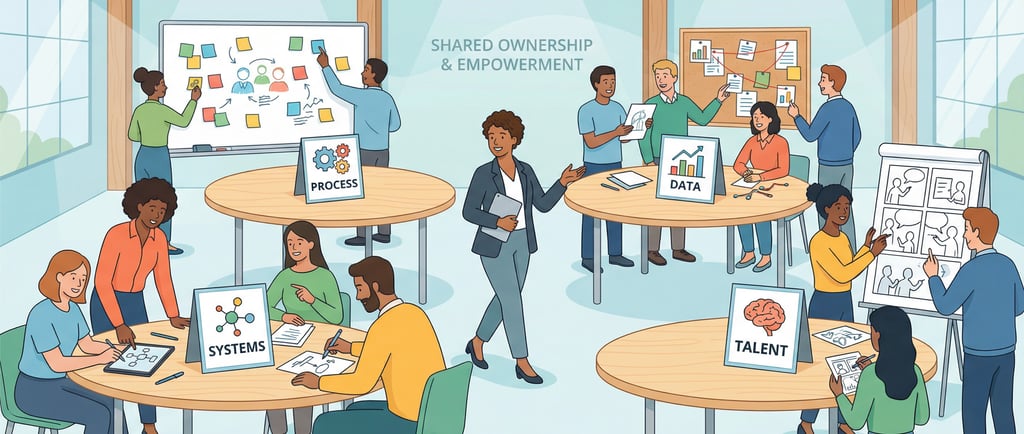
The shift worth arguing for: each workstream owns the story and the enablement for its own changes, and Change Management provides the framework for doing that well.
The New Role of Change Management: Architect and Coach, Not Factory
If workstreams own their own comms and training, what does Change Management do?
Plenty -- and almost all of it more valuable than what it's doing now.
Architect the standards. Create the communication principles: clarity, cadence, audience segmentation, and feedback loops. Define what genuinely good training looks like (scenario-based, integrated into work, not just compliance checkbox events). Build the templates and playbooks that any workstream can adapt for their own context.
Design the overall change experience. Look across all the initiatives hitting the same populations and ensure employees aren't receiving ten conflicting messages from ten different programs in the same week. Help sequence communication and learning so people actually have the space to absorb what's being asked of them.
Coach and challenge. Review workstream communications and training plans against real adoption risk. Is this message specific enough to actually change behavior? Are we addressing the concerns people genuinely have, or the ones we hope they have? Push back when the answer to every adoption challenge is "more training." That's almost never the right answer, and someone with a portfolio view needs to say so.
Hold the portfolio view. Identify which populations are subject to multiple simultaneous changes. Flag when the combined load creates serious risk -- not just for employees, but for the initiative outcomes themselves. Advise on when to slow down, stagger, or add targeted support before it becomes a crisis.
In this model, Change Management becomes the architect of the change system rather than the production team that executes it. That's a fundamentally different and more valuable role.
How to Make the Shift Without Creating Chaos
You cannot simply announce "comms and training are now yours -- good luck" and walk away. That's not a capability shift; that's abandonment. Here's a practical approach that actually works.
Pilot on one major initiative. Choose a program with clear workstream boundaries, visible stakeholders, and enough of your own influence to set the terms. Agree upfront: each workstream will own its own comms and training plans, and Change Management will provide frameworks, templates, and quality reviews. Name those boundaries explicitly, not just in conversation but in the governance documents.
Give workstreams real scaffolding. Provide a simple communication planning template. A training design guide that defines what "good" looks like. Examples from initiatives that went well. Offer office hours or working sessions where teams can bring drafts and get feedback before they're locked in. The goal is to make ownership feel achievable rather than overwhelming.
Draw clear lines. Be explicit about what Change Management will do (standards, coaching, quality reviews, enterprise-wide messaging, executive narratives) and what workstreams must do (audience-specific content, timing, local training logistics). Ambiguity here kills the model faster than anything else.
Capture and tell the story. After the pilot, document what worked, what was hard, and what workstream leads say they learned from the experience. Collect quotes from the people who felt more ownership and credibility as a result. Use that story to build the case for scaling the model across the portfolio.
The Bigger Picture
When you put this together with everything in this series, a coherent picture of modern Change Management emerges.
Change Management isn't a workstream; it's an enterprise capability that shapes how the whole organization changes. Even low-maturity organizations can choose that stance today. A well-designed CMO/TCMO treats change like infrastructure, not a project line item. And every workstream owns its people impact, guided by the standards and coaching that Change Management provides.
That's a very different picture from "own the change lane."
It's also a much more realistic picture of what it will actually take to navigate continuous transformation without burning out your people -- or your change practitioners.
The question worth asking isn't "Who's going to write the emails?"
It's "How are we going to build a system where everyone owns their piece of the people impact, and where change capability is strong enough -- and placed high enough -- to help us change on purpose, not by accident?"
That's the conversation worth having. I hope you'll join it.
If you shifted comms and training ownership to workstreams tomorrow, what's the first thing that would break -- and what does that tell you about who's actually been carrying the accountability?
This is the final piece in a four-part series on repositioning Change Management as a strategic enterprise capability. If this resonated, the whole series is worth reading in order -- each article builds on the last. Start with Article 1: "OCM Isn't a Workstream: Why Change Management Belongs Above the Project Swimlane," then Article 2: "Low Maturity, High Modernity," and Article 3: "Building a Change Management Office That Isn't Just a Project Support Desk."
Contact
Reach out for consulting or speaking inquiries
© 2026. All rights reserved.